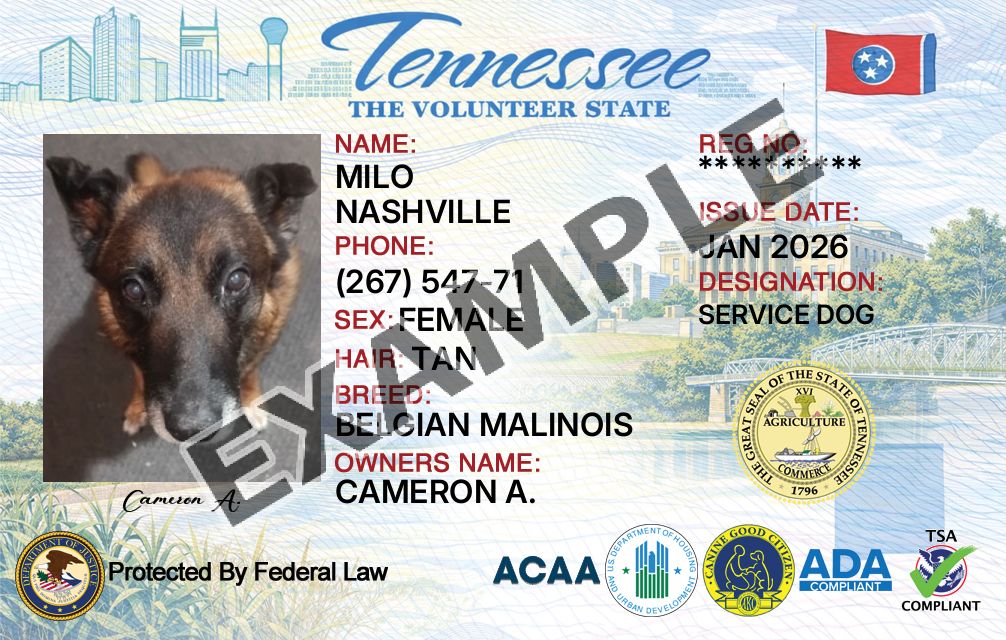
If you’re asking where do I register my dog in Bledsoe County, Tennessee for my service dog or emotional support dog, the most important thing to know is this: in most cases, the “registration” people mean is a local dog license (often connected to rabies vaccination tags), while service dog legal status and emotional support animal (ESA) status follow different rules and are not created by a county license.
This page explains how a dog license in Bledsoe County, Tennessee typically works, which official offices to contact, what rabies documentation you’ll need, and how to avoid confusion between an animal control dog license Bledsoe County, Tennessee process and disability-related laws.
- Dog licensing/rabies tags are local compliance items (proof of rabies vaccination is commonly required).
- Service dogs are defined by federal disability law and do not become “official” through a county-issued license or online certificate.
- Emotional support animals (ESAs) are not service dogs and generally do not have public-access rights; they typically require documentation from a licensed healthcare professional for the limited contexts where ESAs are recognized.
Where to Register or License Your Dog in Bledsoe County, Tennessee
Because licensing and rabies enforcement are commonly handled locally, start with the official county offices below. These are practical places to ask where to register a dog in Bledsoe County, Tennessee, how tags are issued, and which requirements apply in your area (county vs. city).
Bledsoe County Clerk (County Clerk)
- Address: 3150 Main St.
- Mailing: P.O. Box 212
- City/State/ZIP: Pikeville, TN 37367
- Phone: (423) 447-2137
- Email: genese.sapp@tn.gov
- Hours: Mon–Wed & Fri 8:00 a.m.–4:00 p.m.; Thu 8:00 a.m.–12:00 p.m.
Bledsoe County Health Department
- Address: 1185 Alvin C York Hwy
- City/State/ZIP: Pikeville, TN 37367
- Phone: (423) 447-2149
- Email: Not listed in official listing referenced
Bledsoe County Chancery Court Clerk & Master (Courthouse Office)
- Physical Address: 3150 Main St., Ste. 400
- City/State/ZIP: Pikeville, TN 37367
- Phone: (423) 447-2484
- Email: tyler.debord@tncourts.gov
- Hours: Mon–Wed 8:00 a.m.–4:00 p.m.; Thu 8:00 a.m.–12:00 p.m.; Fri 8:00 a.m.–4:00 p.m.
City Court Clerk (Pikeville) — City Recorder
- Address: 47 City Hall Street
- Mailing: P.O. Box 225
- City/State: Pikeville, TN
- ZIP: Not listed in official listing referenced
- Phone: (423) 447-2919
- Email: cityrecorder@bledsoe.net
Overview of Dog Licensing in Bledsoe County, Tennessee
What people mean by “registering a dog”
In everyday use, “register my dog” often means one of these:
- Getting a local dog license (a county or city-issued license/tax/tag, where applicable).
- Showing proof of rabies vaccination and receiving a tag number associated with that vaccination.
- Microchipping (helpful for identification, but not the same as a government license).
- Confusing service dog/ESA status with a license (service dog/ESA status is not created by county licensing).
Why licensing is handled locally
In Tennessee, the exact way a dog license in Bledsoe County, Tennessee is handled can depend on the local rules adopted by the county and/or any city governments. That’s why the best first step is calling a local government office to confirm:
- Whether Bledsoe County issues a specific “dog license,” “registration,” or “rabies tag” process for residents.
- Whether the City of Pikeville (if you live inside city limits) has separate requirements.
- Which office collects any fees and which office handles animal control enforcement.
Rabies vaccination is the key compliance document
In many Tennessee jurisdictions, you must show an unexpired rabies vaccination certificate to obtain a local registration tag or license. Practically, this means your veterinarian’s rabies certificate (and the rabies tag number) is often the document local offices ask for when you’re trying to determine where to register a dog in Bledsoe County, Tennessee.
How Dog Licensing Works Locally in Bledsoe County, Tennessee
Step-by-step: how to ask for the right license or tag
- Confirm your jurisdiction. Tell the office whether you live in Bledsoe County (unincorporated) or inside Pikeville city limits. Local requirements can differ.
- Ask which office issues the license/tag. In many counties, the county clerk is a common place residents contact first for local registrations, but your area may direct you to another office for animal control licensing questions.
- Bring proof of rabies vaccination. Ask whether they require the rabies certificate, the rabies tag number, or both.
- Pay any required fee. If a fee applies, ask what forms of payment are accepted and whether renewals are annual.
- Keep records current. Store copies of your rabies certificate and any local license/receipt where you can access them quickly (especially useful if your dog is lost or there’s a bite report).
How rabies enforcement and animal control can connect to licensing
Local dog licensing and rabies enforcement often work together. Many communities use licensing/tag systems to:
- Encourage rabies vaccination compliance for public health.
- Support local animal control operations and reunite lost pets with owners.
- Provide a clear identifier if a dog is found at large.
If you’re specifically searching for an animal control dog license Bledsoe County, Tennessee, ask the listed offices which department handles animal control calls and whether licensing is issued through the county clerk, health department-related rabies tag distribution, or another county-designated process.
Rabies vaccination requirements (practical guidance)
While exact local ordinances can vary, rabies vaccination for dogs is a widely enforced public health requirement. For licensing purposes, local offices commonly expect:
- A rabies vaccination administered by a licensed veterinarian (or under a veterinarian’s supervision).
- An unexpired rabies certificate (showing vaccine date and when revaccination is due).
- Keeping the rabies tag and certificate available as proof when needed.
Service Dog Laws in Bledsoe County, Tennessee
A service dog is not created by a county “registration”
If you have a disability and use a trained dog to perform specific tasks, your dog may qualify as a service dog. This legal status comes from federal disability law (and related state rules), not from paying for an online certificate and not from a local dog license. In other words:
- You still may need a local dog license like any other dog owner (local public health compliance).
- You do not need a special county-issued “service dog registration” for your dog to be a service dog.
- Service dog work must be task-based (trained actions that mitigate a disability), not just comfort by presence alone.
Public access vs. licensing: two different systems
A local dog license (or rabies tag) is about vaccination compliance and local regulation. Service dog laws are about access and non-discrimination for individuals with disabilities. Even if your dog is a service dog, local licensing rules and rabies requirements generally still apply.
What officials and businesses can ask (practical expectations)
In public settings, people often expect a vest, card, or certificate. Those items can be helpful for communication but usually are not what makes a service dog legally valid. If you’re asked questions, it’s typically about whether the dog is required because of a disability and what work or tasks the dog is trained to perform—rather than “show your registration.”
Emotional Support Animal Rules in Bledsoe County, Tennessee
ESAs are not service dogs
An emotional support animal provides therapeutic benefit through companionship and emotional support. That can be meaningful and medically relevant, but it is different from a service dog because ESAs generally are not trained to perform specific tasks related to a disability.
For someone searching where do I register my dog in Bledsoe County, Tennessee for my service dog or emotional support dog, here’s the key distinction:
- ESA “registration” websites are not government programs and usually do not create legal rights.
- Local licensing (rabies/dog license) may still be required for ESAs just like other dogs.
- ESA recognition is typically documentation-based (for limited situations), not tag-based.
Where ESAs commonly matter (and where they don’t)
ESAs are most often discussed in housing contexts where accommodations may be requested. ESAs generally do not have the same public-access rights as service dogs in restaurants, stores, or other public places. If you’re trying to comply locally in Bledsoe County, focus on:
- Keeping rabies vaccination current and retaining proof.
- Obtaining any locally required dog license or tag.
- Maintaining good control (leash/voice control) and following nuisance and safety rules.
Frequently Asked Questions
Often, yes. A service dog may still be subject to local licensing and rabies vaccination rules because licensing is about local animal regulation and public health—not about disability status. If you’re unsure, call the offices listed above and ask specifically about a dog license in Bledsoe County, Tennessee and whether any fee exemptions exist locally.
Start with the City Recorder / City Court Clerk (Pikeville) listed above to confirm whether the city has additional steps or a preferred contact for animal-related compliance.
Then, contact the Bledsoe County Clerk and/or the Bledsoe County Health Department to confirm how licensing and rabies tag documentation is handled. This is the most reliable way to answer where to register a dog in Bledsoe County, Tennessee when city vs. county responsibilities overlap.
Not always. A rabies tag is typically linked to vaccination and public health tracking, while a dog license can be a local registration or fee-based program. In practice, many residents treat them as part of the same “registration” process because proof of rabies vaccination is frequently required to obtain a local license.
If you’re trying to meet an animal control dog license Bledsoe County, Tennessee requirement, ask your local office whether the county issues a separate license tag, uses vaccination tags for compliance, or requires both.
For local compliance, treat your ESA like any other dog for licensing and rabies vaccination purposes. ESAs are not typically “registered” by county government as ESAs.
If you need ESA documentation for a specific accommodation context, that’s usually handled through healthcare documentation rather than a county office. Local government offices can help with the licensing part (rabies proof, tags, and any local registration steps).
Use clear, local-compliance language. For example:
- “I’m looking to obtain or renew a dog license in Bledsoe County, Tennessee—which office issues it?”
- “Do you require an unexpired rabies certificate to register my dog?”
- “I live (inside Pikeville city limits / outside city limits). Do I follow city or county rules?”
- “Is there a separate process for an animal control dog license Bledsoe County, Tennessee, or is it handled through the clerk/health department?”
Local compliance checklist (quick recap)
- Confirm whether your residence is governed by county rules, city rules, or both.
- Keep rabies vaccination current and retain the certificate.
- Ask the appropriate office about licensing fees, renewal timing, and what tag should be displayed.
- Remember: licensing is separate from service dog or ESA legal definitions.